Positive reinforcement is the most scientifically supported and consistently effective dog training methodology available. According to research published by the Journal of Veterinary Behavior, dogs trained using positive reinforcement methods show significantly faster skill acquisition better long term behavior retention stronger human dog relationships and lower stress indicators than dogs trained using punishment or correction based methods — findings that have driven the global shift toward positive reinforcement as the professional training standard.
On the question of how to train your dog with positive reinforcement, many dog owners still rely on outdated punishment based approaches — not because they want to be harsh with their dogs but because they simply have not been introduced to the principles and techniques that make positive reinforcement training both more humane and more effective than the alternatives.
Positive reinforcement training is not about being lenient or permissive — it is about communicating with your dog in the language their brain is most receptive to and using that communication most efficiently to produce reliable durable behavior change. Dogs trained with positive reinforcement are not merely obedient — they are enthusiastic willing partners who engage actively with training because experience has taught them that training sessions produce pleasant outcomes rather than anxiety inducing unpredictable corrections.
The Science Behind Positive Reinforcement
Understanding why positive reinforcement works so effectively at the neurological level helps trainers apply it more consistently and confidently than relying on technique alone without understanding the underlying mechanism.
Positive reinforcement works through operant conditioning — the learning mechanism by which behavior that produces pleasant outcomes becomes more likely to be repeated. When your dog sits and immediately receives a high value treat their brain records the neural pathway connecting the sit behavior with the pleasant treat outcome. Each repetition of this sequence strengthens the neural pathway — making the sit behavior more automatic more reliable and more enthusiastically offered across different contexts and distraction levels over time.
The immediacy of reinforcement is critical — the pleasant outcome must occur within 1–2 seconds of the desired behavior for the dog’s brain to accurately connect the two events as causally related. Delayed reinforcement loses the behavioral specificity that precise timing provides — the dog’s brain connects the reinforcement with whatever they were doing in the moment the treat arrived rather than the specific behavior that preceded it by several seconds.
The consistency of reinforcement during the initial learning phase builds the neural pathway quickly and reliably — every correct response during initial learning receives immediate reinforcement to establish the behavior clearly before the variable reinforcement schedules that maintain learned behaviors over time are introduced.
Essential Equipment on how to train your dog with Positive Reinforcement Training
The equipment requirements for effective positive reinforcement training are minimal — far simpler than the array of correction devices that punishment based training sometimes involves.
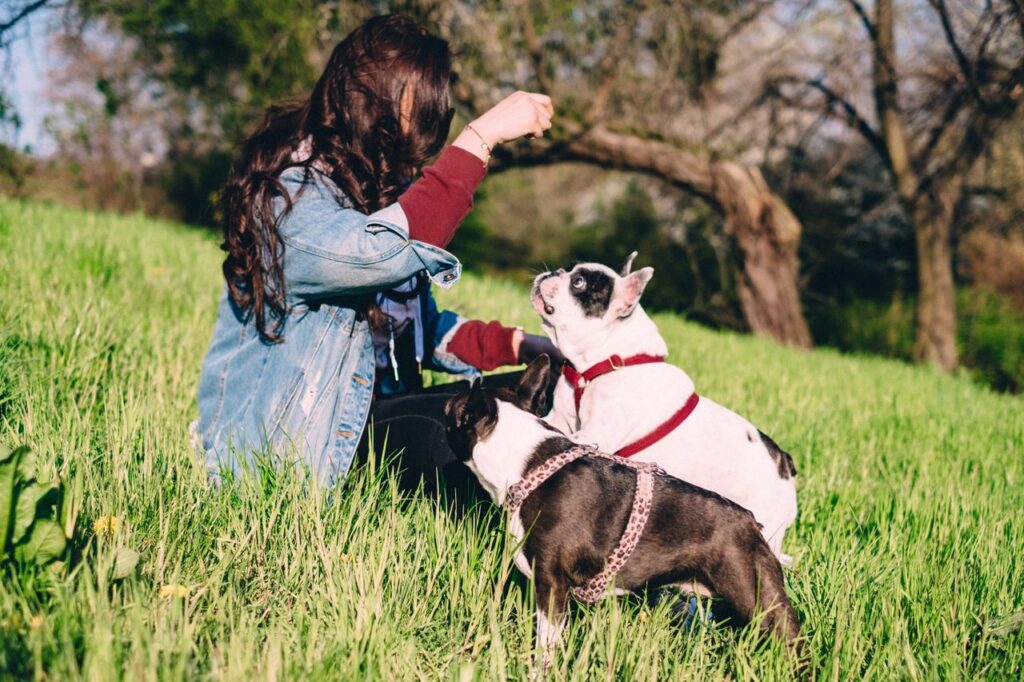
High value treats — The single most important training tool. The treat must be significantly more valuable to your dog than whatever else competes for their attention in the training environment. Small soft treats that dogs consume in 1–2 seconds without chewing interruption allow the rapid repetition that efficient training sessions require.
The treat you use as reinforcement is one of the most important variables in positive reinforcement training effectiveness. Check out our complete guide to the best dog training treats under $50 for the highest value motivating treat options that accelerate learning and make every training session genuinely rewarding for your dog.
A clicker — Optional but genuinely useful for precise timing. The clicker produces a consistent distinct sound that marks the exact moment of correct behavior with greater precision than verbal praise — the consistent mechanical sound bridging the gap between behavior and treat delivery more reliably than variable human voice tones. Many trainers achieve equivalent results with a precise verbal marker such as the word “Yes” delivered consistently at the moment of correct behavior.
A comfortable leash and harness — For walking and recall training. The equipment you use should not distract from the training through discomfort or restriction.
Patience and consistency — The two non negotiable human contributions to successful positive reinforcement training. Dogs learn at their own pace and training progress varies by individual temperament age previous experience and the specific behavior being trained. Consistent patient repetition produces reliable results in every dog regardless of these variables.
Core Positive Reinforcement Principles
Before teaching specific commands understanding and consistently applying these core principles determines whether your training produces reliable lasting results or inconsistent fragile behaviors that fail under distraction.
Reward the behavior you want — not the dog generally
Reinforcement must be precisely timed to the specific behavior you intend to strengthen. Giving your dog a treat because they are being generally good or because you feel affectionate in the moment does not reinforce any specific behavior — it simply provides a pleasant experience without training value.
Set your dog up for success
Structure training situations to maximize your dog’s opportunity to offer the behavior you want to reinforce. Teaching a reliable sit begins in a quiet distraction free environment — not in the park surrounded by other dogs and people where competing stimuli make focus extremely difficult for a dog who has not yet mastered the behavior in easier settings.
Train short sessions frequently
Dogs learn most efficiently in short 5–10 minute training sessions repeated multiple times throughout the day rather than long marathon sessions that produce fatigue and reduced attention quality. Three 5-minute sessions spread throughout the day produces faster and more durable learning than one 15-minute session of equivalent total time.
End on success
Always end training sessions on a successful repetition of a behavior your dog knows reliably — the session ends on a positive note that leaves your dog with a pleasant final training association rather than the frustration that ending on a difficult failed repetition creates.
Progress gradually
New behaviors must be taught in stages from simple to complex — each stage reliably mastered before the next is introduced. Asking for the finished polished behavior before the component stages are reliably established frustrates both dog and trainer and slows overall learning compared to systematic progressive training that builds on solid foundations.
Teaching Basic Commands
Sit
Sit is typically the first command taught because it is simple reliable and creates the focused attention that makes teaching subsequent behaviors easier.
Hold a treat at your dog’s nose level and slowly move it back over their head — as the treat moves backward most dogs naturally rock their hindquarters down into a sit position to maintain their nose near the treat. The moment their bottom touches the floor click or say Yes and deliver the treat immediately.
Repeat this sequence 5–10 times in a session before introducing the verbal cue Sit. Once your dog is reliably offering the sit behavior in response to the hand signal begin saying Sit just before the hand signal — the verbal cue becomes associated with the behavior through repeated pairing with the signal that already reliably produces the sit.
Practice sit in progressively more distracting environments once it is reliable in quiet settings — each new environment initially treated as a fresh learning context where the standard of reinforcement returns to frequent reliable reward before distraction proofing begins.
Stay
Stay builds on a reliable sit by adding duration and distance before the reward is delivered.
Ask your dog to sit then pause for 1 second before clicking and treating — you have just trained a 1-second stay. Gradually extend the duration in small increments of 1–2 seconds at a time — only extending when the previous duration is reliably held across multiple repetitions.
Once duration is reliable introduce small distance increments — step back one step before returning to click and treat. Distance and duration are increased separately rather than simultaneously — combining new duration and new distance creates a difficulty level that exceeds the current training stage and produces the failures that confuse dogs and slow progress.
Come — Recall
Reliable recall is the most important safety command any dog can learn and the command most often trained insufficiently for reliable emergency use.
Begin recall training with short distances in contained spaces — call your dog’s name followed by Come in an enthusiastic encouraging tone and when they arrive deliver the highest value treat in your training toolkit along with enthusiastic praise and brief play. Recall must always produce the most rewarding outcome your dog experiences in training — never use recall to end play sessions, for bathing, for nail trimming, or for anything your dog finds unpleasant during the learning period.
Practice recall across progressively longer distances and higher distraction environments — always returning to short easy distances when introducing significant new distraction levels. A recall that works reliably in your living room but not in the park is not yet trained to a level of reliable safety use — continue proofing across environments until the recall is equally reliable in the highest distraction situations your dog will encounter.
Down
From a sit position hold a treat at your dog’s nose and slowly lower it toward the floor between their front feet — as the treat moves toward the floor most dogs follow it down into a down position. Click and treat the moment elbows touch the floor.
Some dogs resist the down position and need the treat moved slightly forward along the floor away from their body rather than directly downward — finding the movement that produces the down position for your specific dog may require minor technique adjustment from the standard approach.
Leave it
Leave it teaches dogs to disengage from interesting items on cue — one of the most practically valuable commands for preventing counter surfing, dangerous item consumption, and inappropriate item grabbing.
Place a low value treat on the floor and cover it with your hand — when your dog sniffs investigates and eventually disengages from your hand click and deliver a high value treat from your other hand. The dog learns that disengaging from the covered item produces a better outcome than continued investigation. Gradually progress to uncovered treats on the floor and eventually to items on counters and in the environment as reliability improves.
Leash Training with Positive Reinforcement
Leash pulling is the most common dog behavior problem reported by owners and one of the most effectively addressed through consistent positive reinforcement technique that most owners never learn.
The fundamental principle of positive reinforcement leash training is simple — walking on a loose leash produces forward progress and occasional treats while pulling produces a stop or direction change that prevents forward progress. The dog learns through consistent experience that loose leash walking is the behavior that gets them where they want to go while pulling produces the opposite result.
When your dog pulls stop walking completely — become a tree. The moment the leash loosens either because your dog stops pulling or turns back toward you resume walking and mark the loose leash with a verbal Yes or click. Treats delivered frequently during loose leash walking reinforce the position that you want — walking beside you with a loose leash rather than ahead of you pulling against tension.
This technique requires patience and consistency — early training sessions cover very little ground because frequent stops interrupt progress. This is exactly correct — your dog is learning through every stop that pulling does not work. Owners who continue walking during pulling inadvertently teach dogs that pulling is the effective strategy for covering ground quickly.
Leash training using positive reinforcement produces the reliable walking manners that make daily walks genuinely enjoyable rather than a frustrating struggle. For the best leash options to use during positive reinforcement walking training check out our complete guide to the best dog leashes under $50 for safe comfortable and controlled walking equipment that supports your training goals.
Addressing Problem Behaviors
Jumping up
Jumping up is maintained by the attention it receives — even negative attention in the form of pushing away and verbal correction constitutes the social reward that most dogs find sufficiently motivating to maintain the behavior. The most effective approach removes all attention for jumping while heavily reinforcing the sit or four paws on the floor alternative that produces the greeting attention the dog seeks.
Turn away completely when your dog jumps — cross arms avoid eye contact and provide zero attention until all four paws are on the floor. The moment four paws touch the floor immediately deliver attention treats and enthusiastic greeting. The dog learns through consistent experience that four paws on the floor produces the greeting they seek while jumping produces the opposite.
Excessive barking
Identify the barking trigger before attempting modification — dogs bark for different reasons and the effective intervention differs by cause. Alert barking, demand barking, anxiety barking, and boredom barking each require different approaches targeting the specific motivation rather than the barking behavior generically.
For alert barking teach a Quiet cue by waiting for a natural pause in barking then clicking and treating — gradually shaping longer quiet periods before the treat is delivered. For demand barking apply the same extinction principle as jumping — zero attention for barking with immediate attention for quiet.
Chewing inappropriate items
Management prevents the practice of inappropriate chewing during the learning period — preventing rehearsal of the behavior makes training more effective than attempting to train dogs out of behaviors they practice repeatedly. Crate training, baby gates, and supervision during the learning period keep dogs away from inappropriate chewing targets while appropriate chew toys are established as the rewarding alternative.
Training at Different Life Stages
Puppies
Puppies enter what behaviorists call the critical socialization period between 3–14 weeks — the developmental window where positive exposure to people animals environments and experiences shapes lifetime social behavior and confidence. Positive reinforcement training during this period simultaneously teaches early basic behaviors and creates the positive training association that makes adult training faster and more reliable.
Keep puppy training sessions extremely short — 2–3 minutes maximum for very young puppies whose attention capacity is genuinely limited. Focus on socialization and basic engagement rather than complex commands during the earliest weeks and build gradually as attention and cognitive capacity develop.
Adult Dogs
Adult dogs can absolutely learn new behaviors through positive reinforcement — the popular myth that adult dogs cannot be trained is entirely false. Adult dogs may require more patience for unlearning established habits that must be replaced by new behaviors but their learning capacity is fully intact and often superior to puppy capacity for sustained focused training sessions.
Previously punishment trained adult dogs may require additional time rebuilding confidence and motivation before positive reinforcement training reaches its full effectiveness — a patient transition period that the superior long term results consistently justify.
Senior Dogs
Senior dogs continue learning throughout their lives and benefit enormously from the mental stimulation that training provides — cognitive engagement that supports brain health and delays the cognitive decline that unstimulated senior dogs experience more rapidly. Adjust training to accommodate physical limitations — shorter sessions, lower physical demands, and compassionate recognition that cognitive processing speed may require more patience than younger dogs need.
Building Beyond Basic Commands
Once basic commands are reliably established in various environments the positive reinforcement framework extends naturally to trick training, sport training, and the complex behavior chains that enthusiastic trainers enjoy developing with their dogs.
Trick training provides mental stimulation that physically limits dogs enjoy as much as exercise and builds the creative training relationship where dogs begin actively offering behaviors in search of reinforcement — the engaged enthusiastic partner relationship that positive reinforcement training uniquely develops compared to the compliant but unenthusiastic partner that correction based training typically produces.
The progression from basic commands to complex trained behaviors follows the same principles throughout — break complex behaviors into achievable components reward each component reliably before raising criteria and progress at the individual dog’s pace rather than an externally imposed timeline that creates frustration and failure when the dog is not ready for the next stage.